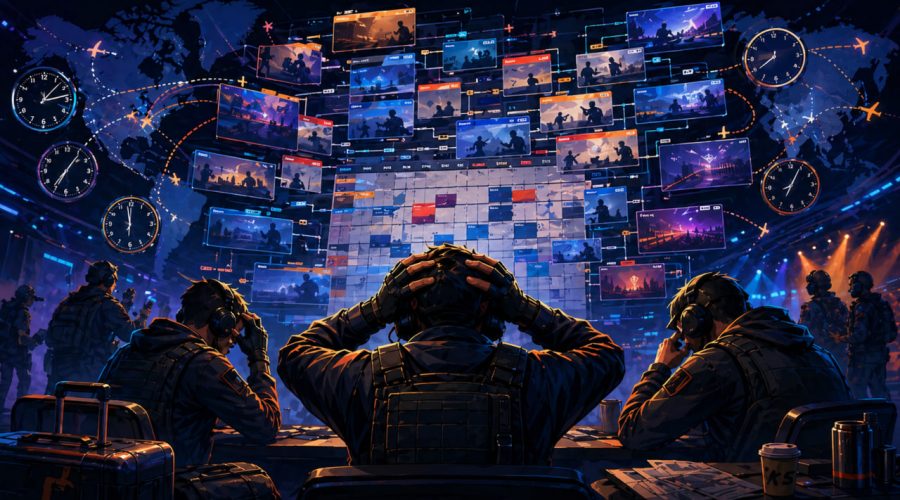
The open circuit was supposed to fix Counter-Strike’s competition problem. For years, the complaint was always the same: too few organizers controlled too many dates, and teams outside the inner circle had no reliable path to tier-one play. Valve listened, rewrote the licensing framework, and handed the keys to anyone willing to meet the requirements. The result, halfway through 2026, is not the balanced ecosystem the community imagined. It is something closer to a scheduling arms race where the calendar itself has become the bottleneck.
How PGL and StarLadder Reshaped the CS2 Events Landscape
When PGL published its full 2026 roadmap back in March 2024, the ambition was unmistakable. Five standalone tier-one tournaments across Cluj-Napoca, Bucharest, Astana, and Singapore, the last of those carrying Major status and a $1.25 million prize pool. StarLadder, riding the momentum of the Budapest Major in 2025, initially matched that energy with multiple StarSeries date claims spanning spring and fall windows. Together, the two organizers staked out 11 top-level event slots in a single calendar year, an unprecedented volume from operators outside the ESL-BLAST ecosystem.
The intent behind those numbers was clear. Both companies positioned themselves not as niche alternatives but as direct competitors for elite team attendance, broadcast attention, and sponsor revenue. PGL framed its expansion as a natural consequence of Valve’s open-circuit philosophy. StarLadder pitched the revival of its historic StarSeries brand as a restoration project for one of Counter-Strike’s oldest competitive institutions. Neither was content to operate in the margins.
That was the pitch. The execution has been considerably messier.
Valve’s Licensing Rules Created Opportunity and Chaos in Equal Measure
The regulatory architecture behind this expansion matters more than most fans realize. Valve’s tournament operation requirements, formalized in mid-2024, split all events into Ranked and Unranked categories with separate licensing tiers. Ranked events feed into the Valve Regional Standings (VRS), which now serve as the primary invitation mechanism for every major tournament on the circuit. Tier-one events for 2026 had to be announced no later than January 1, 2025, and organizers were required to publish detailed additional information, including VRS filters, invitation mechanics, and qualification structures, within strict follow-up windows.
Those deadlines proved to be more than administrative formalities. In November 2025, PGL CEO Silviu Stroie posted publicly that several tier-one events would not take place because organizers had missed the additional-details deadline. He named StarLadder explicitly, stating that none of its tier-one CS2 events in 2026 would happen under the original terms. He extended the same assessment to two of three planned FISSURE Playground events. StarLadder responded within 24 hours by announcing full details for StarSeries 20, scheduled for September 16 to 20, and confirming a tier-one event for October 2027. The spring StarSeries was officially cancelled due to what StarLadder called a scheduling clash with the summer Major window. The public exchange exposed something that the calendar numbers alone could not: claiming dates and actually delivering tier-one events are fundamentally different exercises in the post-licensing era.
The Cancellation Pattern Tells the Real Story
PGL’s own record in 2026 illustrates the gap between ambition and logistics. The company cancelled its planned August event after the Esports World Cup announced an expanded 32-team CS2 tournament with a $2 million prize pool for nearly the same dates. A second cancellation followed when the originally planned early-October slot collided directly with ESL Pro League Season 24 in Katowice. In both cases, PGL cited the impossibility of attracting a world-class field when a competing event of equal or greater prestige occupied the same window.
What remains of PGL’s 2026 calendar is still substantial: Cluj-Napoca in February, Bucharest in April, Astana in May, Masters Bucharest in October, and the Singapore Major closing the year. But the trajectory from the original 11 combined slots to the current, reduced footprint reveals the central tension of the open circuit. More organizers can file for dates. Fewer of those dates survive first contact with a calendar that already belongs, in practice, to ESL and BLAST.
May and September: Where the Calendar Fractures
The stress points are not evenly distributed across the year. May 2026 is the most concentrated window on the circuit. PGL Astana runs from May 7 to 17 with a total prize pool of $1.6 million and 16 teams. IEM Atlanta occupies May 11 to 17. The CS Asia Championships follow immediately from May 19 to 24 in Shanghai. For any team trying to compete across all three, the travel alone, from Central Asia to the United States to China, creates a logistical burden that no amount of prize money fully compensates.
The May 2026 Tier-One Cluster
| Event | Dates | Location | Total Prize Pool | Teams |
| PGL Astana 2026 | May 7–17 | Astana, Kazakhstan | $1,600,000 | 16 |
| IEM Atlanta 2026 | May 11–17 | Atlanta, USA | $300,000 | 16 |
| CS Asia Championships 2026 | May 19–24 | Shanghai, China | $400,000 | 16 |
Three tier-one events across three continents in roughly three weeks. PGL Astana and IEM Atlanta overlap directly for an entire week, forcing teams to choose one or the other. The Shanghai event follows with barely a day of breathing room.
September and October present a similar compression, this time stretching over six weeks that no roster can navigate in full.
The September-October 2026 Tier-One Cluster
| Event | Dates | Location | Total Prize Pool | Teams |
| StarLadder StarSeries 20 | Sep 16–20 | Vaasa, Finland (reported) | $500,000 | 8 |
| ESL Pro League Season 24 | Oct 3–11 | Katowice, Poland | $1,000,000 | 16 |
| Eden Esports Forge of Legends | Oct 13–18 | TBA | $500,000 | TBA |
| Thunderpick World Championship | Oct 14–18 | Malta | $1,000,000 | 8 |
| PGL Masters Bucharest 2026 | Oct 24–31 | Bucharest, Romania | $1,250,000 | 16 |
Five tier-one events packed into 45 days. Forge of Legends and TWC overlap directly. Any team committed to the full fall circuit faces nearly continuous competition from mid-September through the end of October, with the IEM Cologne Major barely three months behind them and the Singapore Major looming six weeks ahead.
Top Teams Are Already Voting With Their Feet
The most telling indicator of calendar overload is not the cancellation list. It is the attendance pattern at the events that do run. Organizations like Vitality, MOUZ, FURIA, and Falcons have already selectively skipped PGL tournaments despite significant prize pools. The reasoning varies by team, but the underlying calculus is consistent: when the schedule forces a choice between a standalone PGL event and preparation for a Major or an ESL Grand Slam qualifying window, the standalone event loses.
PGL Bucharest 2026 offered a case study. FUT Esports won the tournament convincingly, defeating Astralis 3-1 in the grand final and claiming the organization’s first tier-one trophy. The result was meaningful for FUT, who climbed to third in the VRS global rankings afterward. But the event’s viewership told a different story. Average concurrent viewers dropped 29.4% compared to PGL Bucharest 2025, and peak viewership fell by 38%. The field lacked several top-five teams, and popular rosters in Russian- and Portuguese-speaking markets exited early. A tournament with a $1.25 million total prize pool and a legitimate champion should not be generating year-over-year viewership declines of that magnitude. When it does, the calendar is the most obvious explanation.
The ESL-BLAST Duopoly Is Wounded but Not Gone
For all the attention on PGL and StarLadder’s expansion, the structural reality of the 2026 CS2 tournament calendar remains that ESL and BLAST still hold the most valuable real estate. The IEM Cologne Major in June, the first time Cologne has carried official Major status, is the single most prestigious event of the year. ESL Pro League continues to run two full seasons with million-dollar prize pools. BLAST’s triple-tier circuit of Bounty, Open, and Rivals events provides consistent competitive touchpoints across both halves of the year, and the Frequent Flyers Programme distributes a $2 million pool among teams that participate in at least four BLAST events, awarding tokens for attendance, deep runs, and titles.
The ESL Grand Slam, which awards $1 million to any team that accumulates four IEM or EPL titles within a rolling window, creates an additional gravitational pull that no other organizer can replicate. When a team like Vitality is chasing Grand Slam eligibility, every scheduling decision is filtered through that lens. PGL Astana and a potential VRS ranking gain cannot compete with the compound value of another ESL trophy counting toward a million-dollar bonus.
This is the paradox Valve’s open circuit has produced. The door is open for new organizers. The economic incentives still favor the incumbents. PGL and StarLadder have expanded the supply of tier-one dates, but they have not yet built the kind of integrated competitive framework that makes attending their events a strategic necessity rather than an optional addition.
What Needs to Change Before 2027
The 2026 season has already proven that raw event volume is not the same as a healthy ecosystem. Three adjustments would make the open circuit function closer to its intended design.
First, coordination between organizers on calendar placement needs to become standard practice rather than a reactive exercise. PGL has repeatedly adjusted dates after the fact to avoid conflicts it could not have anticipated when its calendar was published two years in advance. A shared scheduling framework, even an informal one, would prevent the kind of head-to-head collisions that have already killed multiple events.
Second, Valve’s deadline enforcement needs clarity. The dispute between Stroie and StarLadder over additional-information timelines exposed ambiguity in how strictly the rules are applied and whether exceptions are granted. If the licensing system is meant to filter out organizers who cannot deliver tier-one logistics, it needs to function transparently.
Third, teams need a voice in calendar construction. The current model asks rosters to navigate a schedule built entirely by organizers and ratified by Valve, with no formal mechanism for player or team input on spacing, travel demands, or competitive load. The fact that top organizations are solving the problem by simply not attending certain events is a signal that the system is not working as designed.
The open era of Counter-Strike was built on a sound principle: more access, more competition, more opportunities for teams and organizers alike. But the 2026 calendar has revealed the gap between that principle and its implementation. Eleven date claims became a handful of surviving events. May and September became logistical minefields. And the teams that were supposed to benefit from a broader circuit are instead forced into triage, choosing which tournaments to skip rather than which to pursue.
The calendar is not broken beyond repair. But it is bending in ways that Valve, PGL, StarLadder, and the rest of the ecosystem cannot afford to ignore much longer. The next six months will determine whether the open circuit matures into a sustainable competitive model or collapses into the kind of fragmented, oversaturated landscape that drove Valve to intervene in the first place.