The Scandal That Landed at the Worst Possible Time
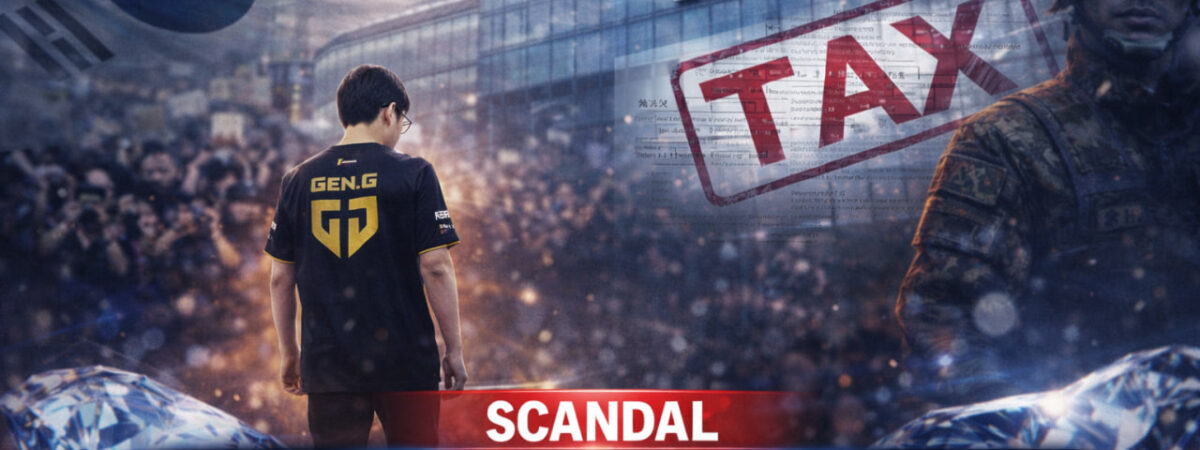
The most decorated bot laner in Gen.G’s history is not making headlines for his gameplay. Park “Ruler” Jae-hyuk is at the center of a tax avoidance controversy that has consumed Korean public discourse, triggered an official LCK investigation, and cast a long shadow over Gen.G’s title defense before the 2026 season has even found its rhythm. And the reason this story refuses to stay inside the confines of esports media is that it touches all three of South Korea’s most combustible civic pressure points at once: taxes, celebrity privilege, and military service exemption.
Here is what actually happened, and why the consequences could extend far beyond a fine.
What the Tax Tribunal Found
On March 26, documents surfaced through South Korea’s National Tax Law Information System revealing that the National Tax Service had concluded Ruler engaged in tax avoidance through a nominal trust arrangement. The case centered on two distinct issues spanning the period from 2018 to 2021.
The first involved payments Ruler made to his father, who had left his own career to support his son full-time. Ruler’s camp argued these were legitimate business expenses for managerial work, including contract negotiations, scheduling, and university-related matters, all performed before Korea introduced a formal certified agent system for esports players. The NTS disagreed. Tax authorities found insufficient evidence that the father’s role qualified as deductible labor, noting that professional gamers already have their teams managing competitive activities and associated costs.
The second, more damaging issue concerned a title trust arrangement on stocks. Ruler had registered investment holdings under his father’s name. Profits and dividends from those investments were reported as the father’s income rather than Ruler’s. Because the father had lower overall earnings, the arrangement reduced the combined tax burden. The NTS classified this as a nominal trust with a tax-avoidance purpose and imposed a gift tax penalty.
Ruler’s side appealed to the Tax Tribunal. The appeal was dismissed on both counts. The tribunal upheld the denial of labor cost deductions and confirmed the gift tax stemming from the title trust. His management agency, Supergent, issued a statement via Instagram insisting that all income taxes had been fully paid at the time of earning, that the penalty gift tax had since been settled, and that the shares were transferred back into Ruler’s name. Supergent framed the situation as administrative negligence, not deliberate fraud.
Ruler himself posted a lengthy Instagram statement in which he acknowledged the two issues, described them as the result of carelessness in managing personal assets, and denied any intent to conceal income. He pledged cooperation with the LCK’s review and committed to greater transparency going forward.
Why Korea Reacted This Strongly
To understand the scale of public anger, you need to understand what Ruler represents in the Korean civic imagination.
In South Korea, nearly every able-bodied male is required to complete mandatory military service, typically around 18 months, before the age of 28 (with some categories of deferral extending the deadline to 30). The exemptions are extraordinarily rare. They are granted to athletes who win an Olympic medal of any color or an Asian Games gold medal, and to select classical musicians, dancers, and artists who are deemed to have elevated national prestige. Fewer than 100 such exemptions are granted in a typical year. Even the members of BTS were not exempted.
Ruler earned his exemption by winning gold with Team Korea at the 2023 Hangzhou Asian Games, where the League of Legends squad swept through the tournament undefeated, beating China 2-0 in the semifinals before taking the final over Chinese Taipei by the same scoreline. That roster featured Zeus, Kanavi, Faker, Chovy, Keria, and Ruler himself, coached by two-time World Champion kkOma. All received exemptions, allowing them to continue their careers uninterrupted by completing a modified service as sports personnel: three weeks of basic training and 544 hours of community service over 34 months.
Military exemptions for athletes are deeply polarizing in Korean society. A 2019 Realmeter survey conducted after the 18th Asian Games found 55.2% of respondents supported the policy for gold medalists while 36.6% opposed it. When esports was added to the Asian Games program as an official medal event, the debate intensified further. For many Koreans, the exemption is a social contract: the state grants you one of its rarest privileges, and in return, you are expected to be beyond reproach as a public figure. Paying your taxes is not just a legal obligation in this context. It functions as a proxy for civic responsibility.
So when a beneficiary of that system is caught in a tax controversy, the narrative shifts. It stops being a question of accounting errors and becomes a question of whether someone who received extraordinary public generosity honored the basic duties that come with it. Korean reporting has explicitly connected the Ruler case to renewed debate over whether the criteria for military service exemptions should be tightened.
The Tone-Deaf Stream
The public reaction might have been manageable had Ruler handled the initial disclosure carefully. Instead, on March 30, just days after the tribunal documents became public, he went live on a personal stream to play solo queue. He did not address the controversy. The broadcast was widely perceived as dismissive, and it accelerated the backlash considerably.
This matters because scandals, particularly in Korea, are shaped as much by the response as by the underlying conduct. The streaming incident hardened public sentiment before Ruler or his team had issued any formal explanation. By the time Supergent released its statement and Ruler posted his personal apology, the narrative had already calcified.
It is worth noting that this was not Ruler’s first brush with disciplinary attention in recent months. In the first round of 2026 LCK sanctions, announced on January 9, he was fined 800,000 KRW (approximately $530) for verbal abuse, a repeat offense following a prior incident in March 2025. On its own, that fine was minor. In the current context, it establishes a pattern that works against him.
How the LCK Is Responding
The LCK confirmed on March 30 that it was reviewing the facts. By early April, the league escalated its response, announcing a formal investigative procedure with an independent committee of external experts. The LCK stated that no provisional measures would be applied before the investigation concludes, meaning Ruler remains eligible to compete in the interim.
That last point is significant. Gen.G opened their 2026 regular season on April 3 against BNK FEARX, a rematch of the LCK Cup Final they had won 3-0 in Hong Kong, and Ruler was in the lineup. The team took a 2-0 victory. They then fell to KT Rolster on April 5, finishing Week 1 with a 1-1 record, identical to T1. The two face off tonight in what was already the marquee fixture of Week 2 before the tax scandal added another layer of narrative weight.
But the competitive calendar does not change the legal and regulatory exposure. Under the LCK Rulebook, cases involving investigations by tax authorities for potential violations of the Tax Act or the Tax Crimes Punishment Act can result in disciplinary measures including a fine of up to 100 million KRW (roughly $66,000) and/or a permanent suspension from LCK and LCK Challengers League participation. The phrase “up to life” is doing real work in that sentence. It means the range of outcomes stretches from a financial slap on the wrist to a career-ending ban, with everything in between left to the league’s judgment of how the tax authority’s disposition should be interpreted.
LCK Disciplinary Action in 2026: Precedents and Unknowns
The LCK has never dealt with a tax-related disciplinary case before. Its existing precedents involve a very different category of offenses.
| Year | Individual | Offense | Penalty |
| 2019 | Cho Gyu-nam (Griffin CEO) | Minor player contract manipulation | Indefinite suspension, later reduced to 24 months |
| 2019 | cvMax (Griffin coach) | Verbal/physical abuse of players | Indefinite suspension, later reduced to 5 months |
| 2020 | OnFleek (player) | Racist remarks | 3-match suspension |
| 2023 | Clid (player) | Inappropriate remarks toward women | 12-month suspension |
| 2026 | Ruler (player) | Verbal abuse | 800,000 KRW fine |
The 2019 Griffin scandal remains the benchmark for severe LCK disciplinary action, but it involved exploitation of a minor player’s contract and allegations of physical abuse. The Clid suspension in 2023 is the closest analog for a player receiving a lengthy competitive ban over conduct outside the game itself.
What makes the Ruler case genuinely unprecedented is that the league must now decide whether a tax ruling that the player has already financially settled warrants competitive punishment. Ruler’s camp has paid the penalties. The shares have been returned. No criminal charges have been filed. The question for the investigative committee is whether the NTS finding alone, and the Tax Tribunal’s refusal to overturn it, triggers the rulebook provision.
What This Means for Gen.G Ruler in 2026
Gen.G made a deliberate decision to run back their 2025 roster intact. In a transfer window where T1 lost Gumayusi to Hanwha Life Esports, where Dplus KIA rebuilt their bot lane entirely, and where 21 roster changes were recorded across the league, Gen.G were the only organization to retain all five starters. Kiin, Canyon, Chovy, Ruler, and Duro return together, with only a coaching change as Ryu replaces KIM at the helm.
That continuity was supposed to be Gen.G’s competitive edge. This is a team that won the 2025 LCK title, the Esports World Cup, MSI, and the 2026 LCK Cup. They were voted the title favorite by nine out of ten LCK teams at the season’s media day. The logic was sound: keep the core, refine the details, take another shot at the Worlds trophy that has eluded Chovy throughout his career.
Ruler is central to that calculus. At 28, he provides the kind of veteran lane stability that allows Gen.G to funnel resources toward Chovy and Canyon without worrying about their bot side collapsing. His 2017 World Championship title with Samsung Galaxy gives him a composure in high-stakes moments that cannot be taught. Replacing him mid-season, should a suspension materialize, would not simply cost Gen.G a player. It would cost them the specific type of player their system is built around.
Gen.G’s academy pipeline does not offer an obvious like-for-like replacement at the LCK level. The organization would likely need to turn to their Global Academy roster or explore emergency options, neither of which inspires the same confidence as a World Champion AD carry with nearly a decade of top-tier experience.
The Bigger Picture
The Ruler controversy is already being discussed in Korea not just as an esports scandal but as a test case for how the industry handles accountability at scale. Esports in Korea has spent years building institutional credibility, from the Asian Games inclusion to broadcast infrastructure to franchise models. That credibility depends on the league demonstrating it can govern its stars with the same rigor applied in traditional sports.
If the LCK treats this as a minor infraction and issues a fine, it risks appearing deferential to a marquee player at a moment when public scrutiny demands the opposite. If it imposes a competitive suspension, it disrupts the league’s most bankable team at the start of the season. There is no comfortable middle ground, which is precisely the kind of decision that reveals whether a governing body has matured beyond its origins.
What is clear is that this is no longer just about Ruler’s finances. It is about whether a league that has benefited enormously from the prestige of the Asian Games, and from the public goodwill that military exemptions confer on its stars, is willing to hold those same stars to the civic standard that the exemption implies. The investigative committee’s ruling, whenever it arrives, will set a precedent that extends well beyond one player’s tax returns.
For Gen.G, the immediate concern is practical: keep winning while the investigation plays out, and hope the resolution is financial rather than competitive. For the LCK, the stakes are institutional. And for Ruler himself, the World Champion who once designed his own in-game skin after lifting the Summoner’s Cup, the task is simpler and harder than any game he has ever played. Prove that the privilege was deserved.